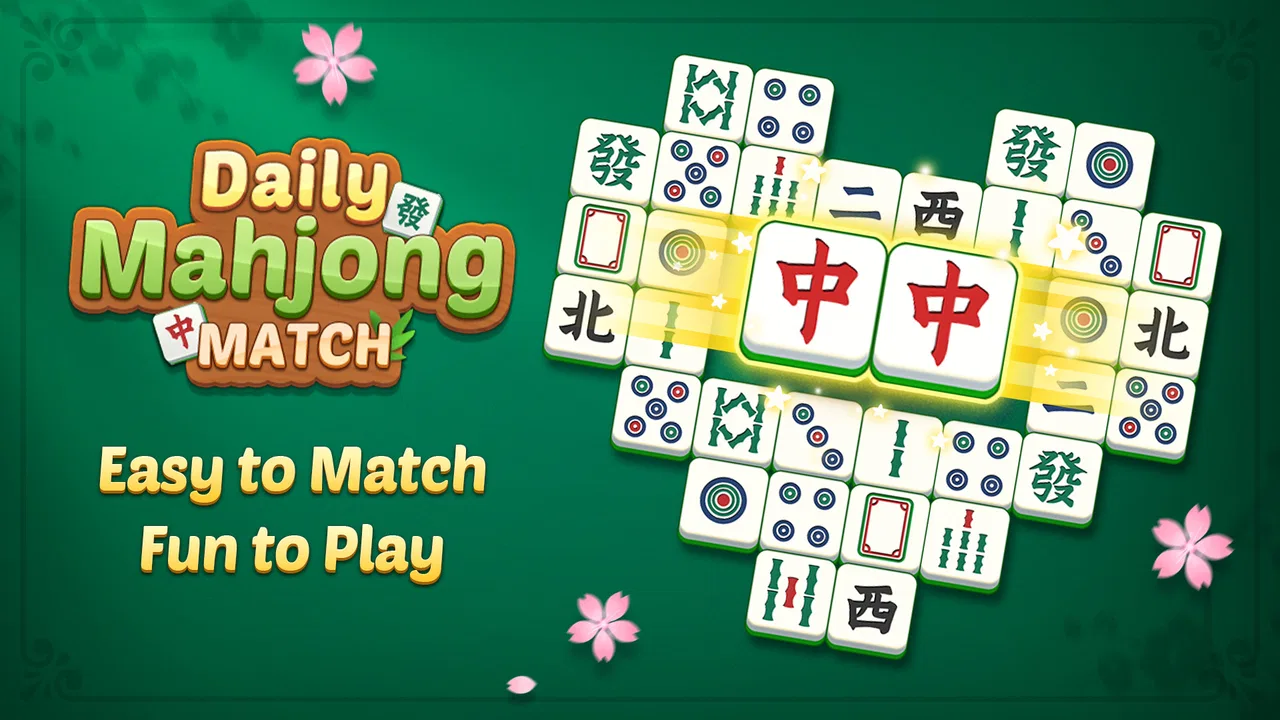
Daily Mahjong Match
- 4.9
- Rating
- 10.00M
- Installs
- Free
- Price

 Analysis by App-foxy
Daily Mahjong Match is the kind of board game I open when I want something quiet, familiar, and easy to understand within a few seconds. It is a free tile-matching game from Big Cake, built around the classic mahjong solitaire format rather than competitive table mahjong. I found its appeal less in surprise and more in the steady comfort of clearing a board at my own pace. The presentation, simple rules, and relaxed tempo work together well, especially when I want a short break that does not demand a story, reflexes, or a complicated tutorial.
That simplicity is also the main thing to judge carefully. This is not a deep strategy game with a campaign to follow, and it is not the right choice if you need constant novelty or intense challenge. Its strength is the small ritual of scanning exposed tiles, making a pair, and watching the layout become lighter. For players who enjoy traditional board puzzles, that focused loop is satisfying. For everyone else, the experience may feel deliberately restrained.
My first impression: a calm puzzle that gets out of the way
My first few minutes with Daily Mahjong Match were straightforward. The game communicates its purpose immediately: identify matching tiles and remove them from a layered arrangement. I did not have to learn a large set of rules before playing, and the board itself remains the center of attention. That makes it approachable for someone who has never played a digital mahjong solitaire game, while still feeling recognizable to people who already know the format.
You May Also Like

 Pandora - Music & Podcasts
Pandora’s Music Is Easy to Start, but Harder to Recover
Pandora’s strength is its low-effort path from a seed to a station. Its weak spot is how much confidence it asks you to place in connection, setup, and quiet recovery.

 AccuWeather: Weather Radar
AccuWeather Review: A Quick, Clear Forecast for Everyday Decisions
For everyday plans, the best forecast is the one you can understand quickly. AccuWeather makes rain timing, radar, and local conditions easy to act on, with a few trade-offs.

 Hill Climb Racing
Why Hill Climb Racing Still Turns Crashes Into One More Run
A tiny car, a bumpy hill and one more upgrade: Hill Climb Racing keeps resurfacing because its simple chaos makes every near-miss feel personal.

 AliExpress - Shopping App
AliExpress Makes Global Shopping Feel Personal, but Shoppers Bear the Risk
AliExpress turns a global marketplace into a pocket-sized discovery engine. Its reach is useful, its shopping loop compelling, and its trade-offs easy to miss.

 Lords Mobile: Kingdom Wars
Lords Mobile Is a Kingdom-Building Routine, Not a Quick Match
A case-by-case verdict on the building, battles, device demands, and social commitments that make Lords Mobile rewarding for some players and exhausting for others.

 PDF Scanner app - TapScanner
TapScanner Makes Paperwork Easier to Capture, Check, and Share
TapScanner makes scanning with a phone feel less like a rescue operation and more like a dependable step in getting work done. Its capture tools are useful, though not flawless.
More From Our News Desk
View All News


The game belongs to the board category, but it plays more like a solitary visual puzzle than a traditional multiplayer board game. There is no need to wait for another player, manage a hand, or understand scoring conventions from tabletop mahjong. Instead, the challenge comes from deciding which available pair to remove first. That distinction matters because the best move is not always the most obvious pair. Clearing one tile can expose another, while a careless choice can leave a difficult arrangement later.
I also appreciate how easily the game fits into small pockets of time. A short session can work after lunch, during a quiet evening, or whenever I want to put down more demanding entertainment. The free download lowers the barrier to trying it, although optional in-app purchases range from $0.99 to $79.99 per item. That wide range is worth remembering before spending: the core attraction is the puzzle board, so I would treat purchases as optional conveniences rather than something necessary to understand the game.
The age rating is Everyone, which matches the accessible rules and gentle presentation. The game is suitable for a broad audience, including older players who may prefer a slower visual puzzle. It also runs on Android versions starting with 6.0, so it does not require a particularly recent operating system. On the popularity side, it has passed five million installs and holds an average rating of 4.9 from roughly 181 thousand ratings, suggesting that its uncomplicated approach connects with many players.
Who will settle into it quickly
I would recommend it first to people who enjoy classic matching puzzles, visual sorting, and games that can be paused mentally at any moment. It is especially comfortable for players who do not want timers, combat, dialogue, or a complicated progression system competing for attention. Someone returning to mobile games after a long break could understand the basic interaction without feeling lost.
It is also a sensible choice for a shared household device. A parent, grandparent, or younger player can pick it up and begin experimenting with pairs without needing a long explanation. The familiar tile imagery gives the game an immediate visual vocabulary, even though the experience is still a digital solitaire puzzle rather than a full mahjong table simulation.
I would skip it if my main goal were social competition, dramatic presentation, or a strong narrative journey. Players who need fast reactions may find the pace too gentle, while strategy fans looking for elaborate planning may eventually want a more demanding puzzle system. The game’s value depends on enjoying repetition with small variations, not on expecting it to reinvent the genre.
How the visual world creates its mood
The art direction is most effective when it stays readable. Mahjong solitaire depends on recognizing tile faces quickly, comparing symbols, and noticing which pieces are available. A cluttered board or overly decorative interface would work against that purpose. Here, the visual language supports the basic act of looking: tiles are the objects that matter, and the surrounding presentation helps frame the puzzle rather than turning it into a busy spectacle.
That creates a particular kind of setting. There is no need for a fictional world with characters or lore because the board supplies its own small environment. Each arrangement feels like a contained tabletop scene. I can focus on the layers, the exposed edges, and the routes that may open after a match. The result is less like visiting a game world and more like sitting down with a neatly arranged puzzle in a quiet room.
The traditional tile imagery does important emotional work. It makes the game feel established and familiar instead of abstract. Even when I am thinking about a simple matching decision, the symbols give the board a tactile identity. This is one reason the game can appeal to older players: the theme does not rely on trendy characters or fast-changing visual effects to hold attention.
There is a practical trade-off here. A restrained visual style can be calming, but it can also make long sessions feel visually similar. If I play several boards in one sitting, the basic pleasure comes from solving new layouts rather than discovering a changing art direction. That is fine for a relaxing puzzle, but it means the game’s atmosphere is consistent rather than expansive.
Reading the board instead of chasing decoration
One useful habit is to treat every exposed tile as part of a map. I do not immediately remove the first matching pair I notice. I look at which tiles are covering others, then consider whether a match will open a useful section of the arrangement. This turns the board into a gentle planning exercise. The art remains pleasant, but the real visual skill is learning to read layers and access.
This is also where the game differs from a basic match-three title. In a match-three board, the player often searches for a move that creates a chain or changes the shape of the grid. In this mahjong format, the important question is access: which pair can disappear now, and what will that reveal? The visual design makes that relationship understandable without needing a large rule panel.
For players with eyesight concerns, the central issue is not the age rating but the ability to distinguish symbols and tile positions comfortably. I would play on a screen size that lets me inspect the board without squinting, and I would avoid rushing decisions. The slower structure helps, but visual clarity still determines how enjoyable the experience feels.
Sound, rhythm, and the feeling of a quiet break
The game’s mood depends heavily on restraint. A mahjong puzzle can easily become tiring if every match is accompanied by loud effects, urgent prompts, or a constant stream of rewards. Daily Mahjong Match works best when the audio and visual feedback remain subordinate to the act of solving. I experience each successful match as a small punctuation mark rather than a dramatic event, which suits the board’s unhurried character.
That rhythm changes how I use the game. I am more likely to open it when I want to settle down than when I want stimulation. A few careful moves can create a useful pause between tasks. In an everyday scenario, I might play while waiting for an appointment or during a quiet commute break, stopping as soon as I feel refreshed. The game does not need a large time commitment to provide that sense of reset.
Its pacing also gives me room to think about mistakes. I can scan the remaining layout, compare possible pairs, and decide whether a move is strategically helpful. This is a better fit for reflective players than for people who measure enjoyment through speed. The absence of pressure can be a strength when I am tired, but it can feel flat when I am in the mood for urgency.
I would still keep expectations realistic about the audio-visual loop. A calm rhythm is not the same as a rich soundtrack or a cinematic presentation. The game’s atmosphere comes from the combination of familiar tiles, gentle progression through a board, and the repeated satisfaction of reducing clutter. Anyone searching for a strong musical identity should look toward a different type of game.
A practical way to use the pacing
I find it helpful to divide a board into small visual zones rather than trying to understand everything at once. First I identify the pairs that are clearly available, then I check whether one choice opens a larger section. After that, I pause briefly and rescan the board. This creates a natural rhythm: observe, remove, reassess. It also prevents the common mistake of playing automatically just because a matching pair is visible.
That approach is particularly useful for older players or anyone who wants the game to remain relaxing instead of turning into a test of speed. The point is not to finish every board as quickly as possible. The more valuable habit is keeping the layout readable and making decisions that preserve future options.
Where the mechanics meet the presentation
The strongest design decision is the alignment between the rules and the mood. Matching tiles is simple enough to begin immediately, but the layered layout gives each move a little weight. I am not only searching for identical symbols; I am deciding which removal improves access. That modest layer of planning keeps the game from becoming a completely mindless tap exercise.
My most useful tip is to avoid spending a promising pair too early when it is helping cover an important area. If two matching tiles are available, I compare what each one is blocking. Removing the pair that exposes more of the board can be better than choosing the pair that looks easiest. This is a small distinction, but it changes the experience from casual matching into light spatial planning.
A second tip is to inspect the edges and upper layers before committing to a move. Newly exposed tiles can change the next decision, and a quick scan after every match helps me notice those opportunities. I also try not to focus only on one symbol family. Looking for a route through the arrangement is often more useful than hunting for a particular tile.
A third trade-off involves session length. Short sessions preserve the game’s relaxing quality, while long sessions can make the repeated board structure feel routine. I would use it as a palate cleanser rather than an all-evening main game. That recommendation is not a criticism of the rules; it is simply the point at which the deliberately narrow design becomes more noticeable.
Compared with match-three alternatives, this game feels slower and more deliberate. Match-three games usually reward quick pattern recognition, cascades, and frequent visual change. Daily Mahjong Match asks for patience and attention to access. Compared with competitive mahjong apps, it is much easier to enter because there is no need to learn a full table game or play against opponents. Compared with elaborate solitaire collections, it offers a more focused experience, but less variety between different card or puzzle formats.
That comparison explains who should choose it. If I want a single, familiar puzzle that I can play without pressure, this is a good fit. If I want a broad package of modes, online rivalry, or increasingly complex systems, another board-game app would probably serve me better. The game succeeds by narrowing its purpose rather than trying to cover every kind of player.
Questions I would consider before installing
Is it genuinely free to start? Yes, the game is available at no upfront price, so I can try its central puzzle without buying it first. I would nevertheless pay attention to any purchase prompts and remember that individual in-app items can cost from $0.99 up to $79.99. For a relaxed tile game, I would set a personal spending limit before exploring optional extras.
Does it require a powerful phone? No recent flagship is implied by its Android requirement; compatibility begins at version 6.0. That makes it a practical candidate for older devices that still run supported software. As always with any board game, the screen itself matters because tile symbols need to be comfortable to read.
Can a beginner play without knowing mahjong? Yes, because the relevant skill is matching exposed tiles in a solitaire arrangement, not mastering the rules of a competitive mahjong table. I would explain the basic idea in a minute: find a legal matching pair, remove it, and use the opening to plan the next move.
Is it suitable for older players? I think so, particularly for someone who likes quiet visual puzzles and does not want fast controls. The Everyone rating and uncluttered concept support that audience. The only personal check I would make is whether the tile faces and board layout are comfortable to see on the chosen device.
Will it replace a deeper strategy game? Probably not. Its planning is meaningful but light, and the presentation is designed to maintain a consistent mood rather than deliver a long-form challenge. I would choose it for calm concentration, not for a complex campaign or competitive ladder.
My atmosphere verdict
Daily Mahjong Match creates a coherent playable mood by keeping its art, sound, and mechanics pointed in the same direction. The tile-based setting feels familiar, the visual focus stays on the board, and the pacing leaves enough space for deliberate decisions. Nothing needs to shout for attention. The pleasure comes from gradually opening the arrangement and turning a crowded layout into a clearer one.
Big Cake has made a game that understands the appeal of a traditional puzzle: the rules are approachable, but careful choices still matter. I like that I can play it while tired, stop without drama, and return later without reconstructing a complicated story or control scheme. The best sessions feel like a quiet mental reset rather than a performance.
Its limitations are equally clear. The narrow format may become repetitive for players who need constant novelty, and the relaxed tempo will not satisfy anyone looking for quick reactions or competitive tension. Optional purchases also deserve restraint because the price range reaches far beyond what I would consider necessary for a simple casual puzzle.
With a current version of 1.0.27 and a release date of February 4, 2025, it is a relatively recent option for this familiar style of game. I would recommend it to anyone who wants an accessible mahjong solitaire puzzle with a calm atmosphere, especially for short breaks or quiet evening play. I would point more demanding players toward a richer strategy or multiplayer alternative. For my own use, though, the appeal is clear: it gives me a focused board, a gentle rhythm, and just enough planning to make each match feel earned.
FAQs for Daily Mahjong Match
01What is Daily Mahjong Match?
Daily Mahjong Match is a puzzle game that offers a modern twist on the classic Mahjong solitaire. Players aim to match tiles with the same symbols to clear the board. The game provides daily challenges, various levels, and themes, making it engaging for both beginners and seasoned players.
02Is Daily Mahjong Match free to play?
Yes, Daily Mahjong Match is free to download and play. However, it offers in-app purchases for players who wish to enhance their gaming experience. These purchases might include additional themes, power-ups, or ad-free gameplay, which can enrich the overall experience.
03What are the system requirements for Daily Mahjong Match?
Daily Mahjong Match is compatible with both Android and iOS devices. For Android, it typically requires version 5.0 or higher, while iOS users need version 10.0 or later. It's recommended to have a stable internet connection for downloading updates and accessing daily challenges.
04Does Daily Mahjong Match offer multiplayer features?
Daily Mahjong Match primarily focuses on single-player gameplay. However, it does include competitive leaderboards where players can compare their scores with friends or global users. Regular updates may introduce new features, so it’s worth keeping an eye on updates for potential multiplayer options.
05How can I contact support if I encounter issues?
If you face any issues with Daily Mahjong Match, you can contact the support team through the app's settings menu. Additionally, their official website provides a contact form and a FAQ section that may address common problems. Ensure you have the latest version of the app, as updates often fix known bugs.
Pros
- Intuitive interface for easy navigation.
- Wide variety of challenging puzzles.
- Visually appealing graphics.
- Relaxing background music enhances gameplay.
- Frequent updates with new levels.
Cons
- Ads can be intrusive at times.
- Limited offline play options.
- No multiplayer mode available.
- Some puzzles are too simplistic.
- In-app purchases can be pricey.

Daily Mahjong Match
Gallery